
The Plenary Speech at the Nanjing 11 th IASS Congress by Youzheng Li Introductory Speech by Prof.Tsai Hsiu-chih, Taiwan University. For Youzheng Lis Humanist Ethics and Future of Semiotics: I am much honored to have this opportunity to intr
Introductory Speech by Prof.Tsai Hsiu-chih, Taiwan University.
For Youzheng Li’s “Humanist Ethics and Future of Semiotics”:
I am much honored to have this opportunity to introduce Prof Youzheng Li, Vice president of International Association for Semiotic Studies (IASS). This introduction will be done both in English, and then, in Chinese.
Prof Youzheng Li plays an important and irreplaceable role in introducing and propagating semiotics to China and the Chinese-speaking areas. His translations and works, ranging from the phenomenological, semiotic, structuralist and hermeneutic studies, initiate an enormous reading population to further understand the Western world of philosophy and culture, and also stimulate a trend to learn and adopt semiotics as a methodology in dealing with human sciences. With his strenuous efforts, affection, and dedication, semiotics in the Chinese-speaking world becomes popular and enriches many intellectual minds which eagerly
search for possible modern approaches to deal with their respective problems.
During the 1990s, Prof Youzheng Li makes his first turn in the academic and the public reading circles from philosophy towards a more thoroughly interdisciplinary-directed semiotic theory based upon pan-semantic institutional analysis, as the restrictiveness and exclusiveness of the philosophical-centered fundamentalism of the established conditions of human sciences are concerned. Henceforth, he advocates the classical epistemological attitude towards reality of all kinds, such as the historical, cultural, social and academic realities, and the return to the scientific and rational traits of the original semiotic practice.
In recent years, having strengthened and extended his research power and critical analyses to a wide variety of the contemporary human sciences, Prof Youzheng Li makes his second turn–a stride from pan-semantic institutional analysis towards Ren-humanist ethics. This new proposition insists on intellectuals’ realizing their social responsibility towards the increase of happiness of all human kinds, and its relation to the importance of inquiring about a new humanist ethics based on a semiotic- and hermeneutic-directed, cross-cultural historical theory.
Now, we are very pleasant to have Prof Youzheng Li to share with us his concepts of this new humanist ethics. The title is “Humanist Ethics and Future of Semiotics.”
各位尊敬的貴賓:今天這個場次的第一位演講者為國際符號學學會副會長李幼蒸教授。
李幼蒸教授對於符號學在國內與世界華語文區域的引進與推廣,扮演著極其重要、而且不可取代的地位。他所翻譯的作品與著作種類甚多,而其所涵蓋的內容,包含現象學、符號學、結構主義和詮釋學等各方面,讓眾多華語文讀者對西方哲學與文化有進一步理解,同時也引發大家學習與採用符號學作為方法論研究人文科學的風潮。經由他熱誠、奉獻與持續不懈的努力,符號學在華語文地區因而得以風行、同時也豐富了許多積極尋求現代方法,以解決其各自問題的知識份子的心靈。1990年代,深刻考慮到以哲學為中心的基本教義主義的限制性與排他性,李幼蒸教授在學術與公眾閱讀領域內有了第一次的轉向——從哲學轉向更為完整的、立基於機構性泛語意分析、以跨學科為導向的符號學理論。此後,他主張以古典認識論的態度,面對現實的諸多層面,例如:歷史、文化、社會與學術現實,並重返原初符號學實踐對科學與理性的訴求。近年來,持續不斷強化研究實力與批判分析能力,並將之擴展到當代人文科學的許多項目上的李幼蒸教授,開始了他的第二次轉向:此次,是由學術體制內泛語意分析跨步邁向以人為主的倫理學。這個新主張強調知識分子必須了解,他們對增進人類福祉的社會責任,以及他們的探求與立基於以符號學和詮釋學為導向的跨文化歷史理論的新人文倫理學之間的關係。
今天李幼蒸教授將與我們分享他有關新人文倫理學的主張。他的演講題目為:〈人本主義倫理學和符號學的未來〉。歡迎李幼蒸先生。
(2012,10,07 Monday 10:40-11:50 )
Humanist Ethics and Semiotics in Future
(A Plenary Speech for the Nanjing IASS 11thCongress 2012)
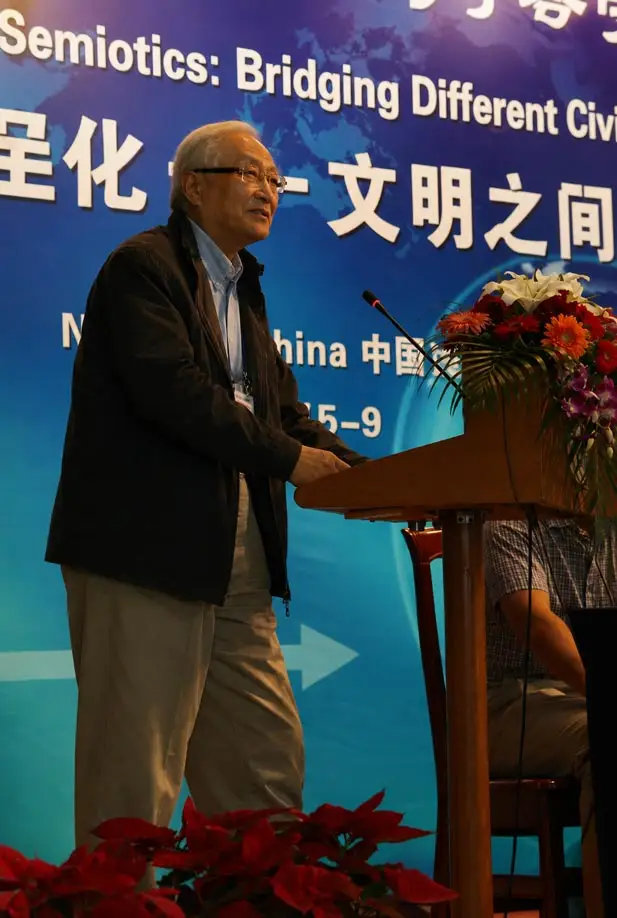
This Nanjing IASS Congress, as the first genuinely global semiotics congress in IASS history, should become a forum where the modern semiotic movement be systematically reexamined and reevaluated with respect to its achievements and shortcomings alike during the past one hundred years; and then within the intellectually expanded context we should consider how to make it progress further more creatively. It’s well known that all contemporary applied semiotics have clearly achieved a great success in respective scientific fields. The main problem remaining in our semiotic field today is still related to the so-called general semiotics or semiotic theory in general. There are two reasons why general semiotics is important for us: first, all modern semiotic practices are related to either the philosophical or the general-linguistic theories; and second, the current semiotic way of thinking is related to the development of human sciences as a whole. In other words, considering its origins and future development, semiotics is connected with a much more general theoretical background that defines its identity and its prospect. That’s why the discussion about general semiotics has been always a key part in IASS activities for the past decades; and its significance is also due to the fact that there have existed too many divergent approaches of general semiotic theories within the scholarly experiences of IASS, the theoretical divergence itself should be clarified. In addition, when IASS is expanded to the non-European-American areas, including the land of Chinese civilization, the problems about identity of general semiotics even become more seriously important and challenging, for it is also so much widely and deeply tied with the orientation of modernizing Chinese humanities, and the latter is therefore even linked with the self-critical reexamination of western human sciences as well.
The present paper attempts to talk about the several key issues regarding a global semiotic theory in terms of a present-day Chinese intellectual and historical stance. In general, my talk contains three main sections: A. redefinition of general semiotics; B. protection of scientific rationality; and C. a necessity for reestablishing ethical subjectivity against commercialized professionalization.
(A). The new conception of semiotics: Semiotics and the semiotic elements in our academic-globalization era
The essence of semiotics lies in finding out the more relevant, relatively independent theoretical elements from different modern disciplines and then recombining them in the specially designed projects. This is equivalent to the interdisciplinary approach. The interdisciplinary tendency is scientific-orientated in nature; that is similar to what we see in the development of natural sciences: the progress of the latter is made through alternating processes of disciplinary specialization and interdisciplinary communication. The similar scientific progress in the humanities is realized first of all through breaking up the traditional academic system that has been guided by or under control of the philosophical way of thinking. It’s reasonable that when different traditions of the humanities in the world have been intermixed or mutually influenced the interdisciplinary approach becomes multiply enriched, following the cross-cultural semiotics emerges. That’s why we can say the present-day cross-cultural semiotics starts a new stage for the modern semiotic movement, demanding to further strengthen the cross-cultural-directed interdisciplinary exploration. In addition, in the world of western social and human sciences, for the past decades we see the unprecedentedly increased interdisciplinary development mainly based on the contemporary structural movements. The two developments have changed the panoramas of current global semiotics and even global human sciences as well. Firstly, the basically changed semiotic situation presses us to more suitably redefine the semiotic practice, that on one hand prevents the current tendency of semiotics going back to the single disciplinary notion under the professional-competitive pressure and on the other opposes the current semiotic tendency to search for certain type of philosophy as its theoretical foundation. It seems that the direct result of the two efforts keeps a theoretical and genetic tie with the traditional definition of semiotics as a study of signs. No, the multiply changing of contemporary semiotic practice can no longer accord with such a simplified definition based on mere linguistics and history of signs. Instead, the semiotic should be a study of synthetically institutionalized and institutionalizing mechanisms of formation, operation and effectuation of the semantic and communicative production in general. It represents a general epistemological and methodological development of global human sciences in our new century. Or in other words, the semiotic practices are definitely part of entire human sciences of the world. It is due to this significant link that the semiotic way of thinking could become so important today. Therefore the semiotic practice signifies an epoch-breaking turning point of scientific modernization of human sciences. That’s why we should get together here to reconsider the past, present and future of the semiotic movement.
According to this more flexible understanding of the term ‘semiotics’ there should be two parts in it: one is the more concrete, tactic, methodological, operative procedures currently employed in our customary semiotic practice; and the other is the more general, abstractive, epistemological, strategic patterns in connection to the total situation of human sciences, including both the western and non-western parts.
B. Safe-guarding of rationality: Postmodernism is a philosophy typical of the commercializational-domination era
The above-mentioned new scientific task of semiotics needs first of all to maintain or strengthen the full rationality in its theoretical practice. The first principle for our current semiotic movement is to defend rationality that needs to be understood today as a multi-layered rational scheme within our interdisciplinary/cross-culturally changed academic world, rather than as certain traditionally fixed procedures. In other words, the ever-more intensified demand for academic rationality should be realized in dividing the top theoretical level and the next applied ones that are used in the present-day professional systems. Regarding the task of semiotic renovation we do not need to limit ourselves in those current available operative patterns employed in our semiotic-theoretical profession, if the latter proves less productive in promoting our true scientific projects. The interdisciplinary/cross-cultural tendency of current semiotics allows us to reorganize our semiotic strategy through firstly establishing our top rational principles in terms of entire human intellectual history.
In history of humanist rationality there emerged two big different traditional origins 2000 years ago: the pre-Christian Greek and the Pre-Confucianist Chinese. The Greek origin is embodied in its logical reasoning and the Chinese one in its humanist ethical empiricism. The former has been transformed into different stages, including their modern western-scientific-technical type; the latter, despite its historical deformations, has been always maintained its essence in Chinese cultural history. The basic identity of rationality amounts to the scientific one, that must consist of the two necessary parts of the original rationality: logical reasoning and empirical reality. The two essential parts are contained in all western-produced sciences except the one in connection with the reality of subjectivity.
When we call semiotics a science, it should be originally founded and further checked by the two criteria of the original rationality, basically embodied in their modern versions. In light of this we may practically mention 4 top types of human rationality which are connected with the notion of semiotic rationality here:
- The empirical-pragmatic principle, that is typically embodied in modern history of England;
- The logical-systematic principle, that is typical in modern history of German-speaking countries;
- The Social/cultural positivism, that is typically expressed in modern history of France;
- The humanistic-empirical ethics, which is spiritually realized in Chinese long cultural history.
The first three top principles, originating in the Greek-Roman traditions, are the exactly those employed in natural and social sciences. The fourth comes from Chinese civilization and its relevance to the modernizing tasks of semiotics in particular and human sciences in general lies in its essential coherence with the first three principle with respect to the actual human and social world. In other words, the humanist ethics provides human sciences with an additional empirical and actual ethical rationality that can be in actively productive interaction with the other three principles. And this empirical-directed humanist ethical doctrine without any transcendent elements has been almost an unique one in human history.
By the way, we need to explain that the principles as such cannot be confused with the actual historical developments relatively and mere partly implicate those principles. Today we can epistemologically discern and methodologically select relevant rational elements from the related historical experience. For example, there are a great number of rational elements within various departments in the philosophy as a professional field to be selectively used, but we must keep distinguishing the former from the latter. Or, any philosophy will not be accepted as a total system, or only parts of it can be picked out for our newly designed projects. The fact also indicates that any philosophical schools, especially those with traditional metaphysics and ontology as their centers, can no longer be adopted as the theoretical foundations. In a word, we attempt to distinguish the scientific-rational elements implied in philosophy from the philosophical institutionalization rooted in the traditional academic framework. In light of this, any postmodern ontological rhetoric should be therefore definitely excluded from the scientific-directed semiotics. By the way, any postmodernist nihilism or extreme relativism has already become the main theoretical obstacle for the progress of Chinese new human sciences.
If the selective use of above four rational principles can become our scientific-practical foundations we become more able to guarantee the rational orientation of semiotic and human-scientific modernization. Thus, human sciences, including their semiotic part, should be in harmony with natural and social sciences as well because they share the common rational principles based on worldly reality and empirical logic. The identity of the scientific practice implies reality and logic. If natural and social sciences do not allow any transcendent elements in their composition, the same should be the case with human sciences. When Derrida opposes the conception of human sciences as such, he in fact opposes the scientific spirit itself.
The main obstacles of rational modernization of semiotics and human sciences lie in two intellectual sources: the existential nihilism and narrow-minded scientism. The former tends to make semiotics look like the artistic game and the latter tends to make semiotics lose its really relevant rational elements. Simply, the latter conceives semiotics mechanically following the model of natural science or technique. The both, by different ways, undermine the genuine rationality of semiotics and human sciences alike. In consequence, objectively speaking, the both represent the intellectual trends to serve the benefits of the commercialized technical globalization in this world.
C. A Justification of subjectivity: A logical necessity for reestablishment of ethical subjectivity in humanistic academia
The above sections A and B are about a new recognition of identity and nature of the semiotic, and the present section C is about the semiotic pragmatics; namely how to organize our academic efforts for realizing the rational task mentioned above? The present-day situations of the global technical-commercialized world is in co-ordination with normal developments of natural and social sciences but indicates an essential disfavor against rationalization of human sciences which includes semiotics as their scientifically self-improving weapon. In such a totally commercialized world all academic professions couldn’t help following the rules of the marketing domination. Accordingly, the humanistic scholars and semioticians living in such a professionalized world tend to give up the traditional philosophical motivation for objective truth, instead they search for the mere professional success. This social-objectively fixed tendency is structurally contrary to the scientific goal for rationalizing human sciences. Because the scientific practice exactly means the aim for pursuing objective truth. This is another aspect of our epistemological reflection on the present-day semiotic movement. The scholar lives in a mutual oppositional tension between the different philosophies of life: either doing scholarship for the sake of attaining truth or doing scholarship for the sake of practical benefits only. On the other hand we know clearly that one of the common characters of contemporary western philosophical trends is the general tendency for destroying the theory of subjectivity and subjective ethics. Even both rational and irrational ways of thinking existing under the pressure of present-day technology-dominating social logic hold the similar anti-subjective epistemological position. By contrast, according to the humanist ethics, without autonomy of subjectivity, no independent choice of the scholar who loses subjective will. In addition, also according to humanist ethics, the subjective-ethical and the objective-moral belong to different epistemological dimensions. And, as far as I know, in western ethical history, the two directions have been all the time confused epistemologically. Briefly, there exist three different categories in ethics: personal happiness, interpersonal justice and the personal attitude towards the former two. The last one belongs to the ethics of subjectivity. So we are unable to destroy the subjective aspect as an “attitudinal ethics”. The historical Chinese humanist ethics uniquely keeps a focus on the pragmatic wisdom of a subjective ethics that happens to be reflected in our present-day humanist-directed scientific reconstruction practice.
Heidegger as the first enemy of rationality in last century cherishes a life-long ambition to destroy the orientation of Husserl’s rational phenomenology, and regretfully even so many western phenomenology philosophers could have been misguided by his ontological rhetoric. It is a pity that even so many experts in Husserl have overlooked the so important implication of the subjective ethics in Husserlian learning. In fact, without attaining his final ethical stage during his whole life Husserl still provides a uniquely solid foundation for reestablishing the notion of ethical subjectivity in a modern logical way. For it seems that he could positively experience that without a solid subjectivity there is no ethics after all.
It is highly interesting to note that there exists an alien type of “theory” of ethical subjectivity, namely the one in an intuitive and practical mode, that is the so-called “learning of mind” along the traditional Chinese Ren-humanist ethics. It is a doctrine that the true impetus of ethical action lies in one’s genuine awakening and “Affektion”of ethical consciousness rather than in the pure intellectual knowledge. In other words, a ancient Chinese philosopher Wang Yangming’s learning indeed explores how to shape a truly effective subjectivity that is able to make ethical choices realizable; or, without such productive living subjectivity the ethical practice becomes hardly possible. By the way, we may here reemphasize a rejection of Kant’s doctrine of so-called Absolute Imperative. It is Confucius who states: there exist only few people who can genuinely realize ethical actions among human beings. This empirical-founded statement indicates that we should distinguish between the subjective-ethical and the objective-moral, the later should be realized in social, political and legal channels. But only the former is logically linked to the scientific quality of the humanist-scientific scholars, for whom there exist no objective standards for truth within human sciences but there indeed exists the subjective choice for adopting an attitude towards truth. If humanistic scholars prefer the professional success to the scientific truth, that indicates they prefer to be under control of social competitive mechanism.
In terms of different approaches, Husserl and Wang Yangming, the one logical-epistemological and the other intuitive-practical, similarly search for the really qualified ethical subjectivity. This seemingly subjectivist vision of ethics tends to resume its significance and efficiency under our present living conditioning caused by the professional commericialization of our era. The topic raised here has nothing to do with any speculative reasoning but been related to the very social-empirical reality with respect to the life-style of the humanistic scholars: For scientific truth or for whatever professional success in your life?
In the slogan “Rereading Husserl” we attempt to strengthen the exploration of Husserlian subjectivity through semiotically excluding the related metaphyiscial-ontological dogmatism, namely finding the relevantly theoretical elements in our reorganized rational framework; and by the slogan “Rereading Wang Yangming” we attempt to modernize a hermeneutic ethics of subjectivity through semiotically excluding the Confucianist social and academic ideologies. Quite interesting, it is the current semiotic epistemology that urges us to reconnect the human sciences with subjective ethics.
(2012,10,7,Morning)